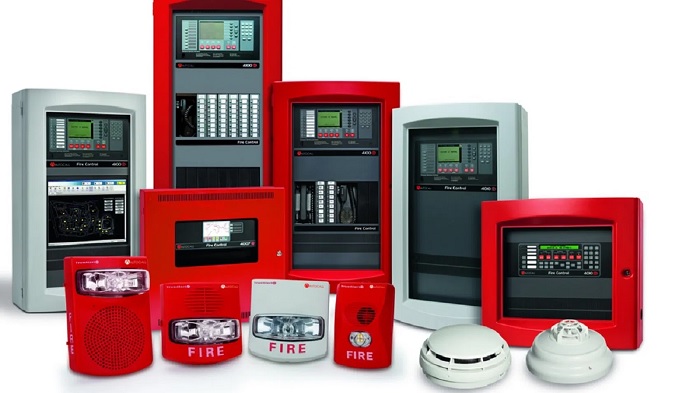
Introduction
The fire alarm system can be set off automatically by smoke detectors, heat detectors or manually. These sensors are set to detect certain levels of heat or smoke that could be an indication of fire. A loud bell or a siren, sometimes accompanied by blinking or flashing lights for individuals who have hearing problems, blasts to alert occupants in the building. To truly understand how a fire alarm system works, let us go further into the components of the fire alarm system. In a fire alarm system there is always a smoke detector to detect smoke or fire.
Another aspect of how a fire alarm system works is the heat sensor or also called thermal sensor. A fire alarm system works by way of heat sensor in quite simple way. The heat sensor monitors the temperature in a room and any abrupt rise or sudden extreme change in temperature triggers the fire alarm.
How does a fire alarm system work by way of smoke sensor? There are two types of smoke detectors.
These are the optical detector and the ionization detector. The optical smoke detector detects smoke by using light sensors (infrared LED). When smoke particles pass through the chamber of the optical detector, it scatters light that triggers the alarm. In the ionization detector, if the smoke particle enters the chamber of the ionization detector it will reduce air ionization inside the chamber of the ionization detector and triggers the alarm.
Conventional Fire Alarm Systems
Fire Alarm Systems fall broadly in to two groups - Conventional Systems or Analogue Addressable Systems.
'Conventional' Fire Alarm Systems, in their various forms, have been around for many years and have changed little in that time in terms of technology although design and reliability have improved significantly. However, Conventional Systems are a well-proven technology protecting many hundreds of thousands of properties worldwide. A Conventional Fire Alarm System is often the natural choice for smaller systems or where budget constraints exist.
In a typical Conventional Fire Alarm System the 'intelligence' of the system resides solely within the Fire Alarm Control Panel which receives a trigger signal from a Conventional Detector or Call Point and in turn, signals the condition to other devices such as alarm sounders and remote signalling equipment.
Conventional detectors are normally connected to the Fire Control Panel via dedicated circuits, each circuit protecting a designated 'Zone' or 'Area' of the building (the maximum size of which will often be governed by local standards). Detectors have two states, Normal healthy and Alarm.
Addressable Fire Alarm System:
Addressable fire alarm systems offer benefits in speed of detection, identification of the location of a fire and easier maintenance. Addressable fire alarm systems also offer tolerance to faults in the system wiring, which allows a single pair of wires to be used to connect up to 200 devices to the system, allowing cost savings in the wiring of large systems. In larger installations, the benefits of improved maintenance and reduced cabling cost are overwhelming. The price difference between Addressable systems and conventional systems has narrowed to such an extent that even for small installations, the use of an Addressable fire alarm system should be considered.