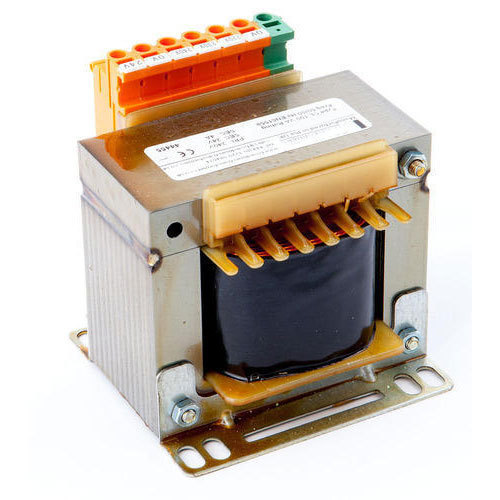
1. Why is transformer not used in DC supply?
Transformer operation requires alternating magnetic flux. In DC supply there is no alternating flux, so secondary voltage is not induced as required for transformation.
2. Why transformer is rated in kVA?
Transformer losses depend on voltage and current, not on load power factor. Because of that, transformer capacity is specified in kVA rather than kW.
3. What is a control isolation transformer used for?
A control isolation transformer is used to provide a stable and isolated power supply for control circuits, relays, contactors, timers, PLC interfaces, and other auxiliary devices in industrial panels and machines.
4. What is the difference between a control transformer and a power transformer?
A control transformer is designed mainly for control and auxiliary circuits, especially where good voltage regulation and high inrush current handling are important. A power transformer is intended for bulk power transfer and distribution at higher load capacities.
5. Where are control isolation transformers commonly used?
They are commonly used in motor control centers, PLC panels, machine control panels, CNC systems, process plants, instrumentation circuits, printing machinery, textile machines, and OEM automation equipment.
6. Can control isolation transformers be customized?
Yes. They can be customized for primary and secondary voltage, VA rating, winding material, insulation class, tapping arrangement, enclosure type, and mounting style to suit the panel and application requirement.