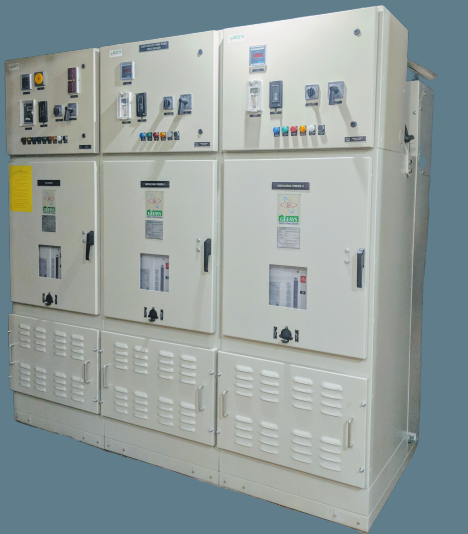
1.Why we are using VCB in HT side?
Vacuum Circuit Breakers are widely used on the HT side because they offer reliable arc quenching, low maintenance requirements, long service life, and dependable switching performance. Compared with conventional breaker technologies, VCBs are compact, safe, and suitable for repeated operations in medium-voltage systems.
2.What is HT Breaker?
An HT breaker is a high-tension circuit breaker used to switch and protect medium-voltage electrical systems. In many HT panels, vacuum circuit breakers are used to interrupt fault current safely and isolate the power circuit during abnormal conditions or maintenance.
3.What is an HT panel used for?
An HT panel is used for receiving, controlling, protecting, and distributing high-voltage electrical power in industrial plants, substations, commercial facilities, and infrastructure projects. It helps manage feeders, transformers, and incoming or outgoing power circuits with proper protection and metering.
4.What are the main components of an HT panel?
A typical HT panel may include vacuum or SF6 circuit breakers, busbars, protection relays, CTs and PTs, metering instruments, control wiring, isolators, earthing switches, annunciation systems, and enclosure compartments. The exact configuration varies based on system voltage and application needs.
5.Where are HT panels commonly installed?
HT panels are commonly installed in industrial facilities, substations, power distribution rooms, process plants, commercial complexes, and utility applications. They are used wherever medium-voltage power needs safe switching, protection, and controlled distribution.
6.Can HT panels be customized for project requirements?
Yes. HT panels can be customized for operating voltage, fault level, breaker type, feeder arrangement, metering, relay protection, SCADA integration, enclosure design, and installation environment. This helps the panel match the electrical scheme and operational requirements of the project.