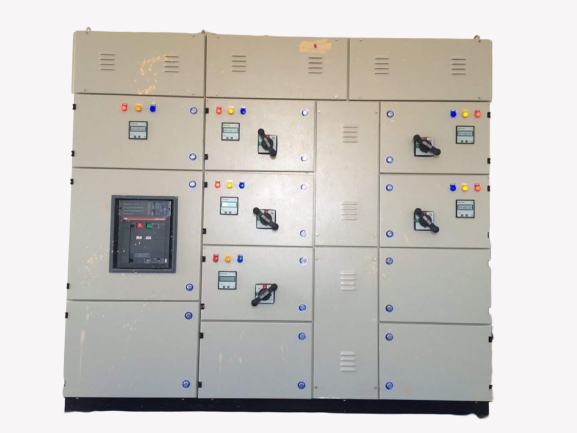
Solar LT Panel Manufacturer India for Solar Power Plants
GEESYS designs and manufactures Solar LT Panels for solar power plants that need reliable low-tension AC distribution after inverter conversion. These panels are used for inverter output pooling, Solar Main LT Panel duty, feeder protection, metering, isolation, and controlled power evacuation in commercial, industrial, rooftop, and utility-scale solar projects.
GEESYS Solar LT Panel Boards are configured for project-specific voltage class, feeder count, busbar material, metering, protection devices, cable entry, and enclosure location. The same product family supports Solar Main LT Panel duty, inverter pooling, metered AC distribution, and LT panel requirements for solar power plant projects across India.
Primary useAC-side solar distribution and feeder control
Voltage class415V to 800V AC project-specific designs
ApplicationsRooftop, industrial, commercial and utility solar
DeliverablesGA drawing, SLD support, wiring and test records
Reference Solar LT Panel image. Final layout, feeder count, busbar sizing, metering and protection devices are configured from the project SLD.
A Solar LT Panel is a low-tension AC distribution panel used after solar inverter output. It combines, protects, meters, isolates, and distributes AC power from inverter blocks to loads, transformers, net metering panels, or power evacuation systems.
What Is A Solar LT Panel?
A Solar LT Panel is the low-tension AC distribution panel used on the AC side of a solar power plant. It sits after the inverter stage and before downstream loads, transformer feeders, metering panels, or evacuation points. The panel may receive one or more inverter outputs, distribute power through protected outgoing feeders, monitor electrical parameters, and provide manual or automatic isolation when maintenance or fault response is required.
In a small rooftop solar plant, the Solar LT Panel Board may be a compact AC distribution board with MCCB, MFM, SPD, indication, and cable termination space. In a larger industrial or utility solar project, the Solar Main LT Panel becomes a major distribution assembly. It may include ACB incomers, multiple MCCB feeders, CT metering, busbar chambers, outgoing transformer feeders, auxiliary supply circuits, control wiring, alarm contacts, and segregated cable entry sections.
Solar LT panels are often confused with Solar ACDBs, LT distribution panels, and HT panels. They are related, but their job is not identical. A Solar ACDB commonly handles AC protection at smaller project scale or specific inverter output levels. A Solar Main LT Panel handles a broader distribution role and may become the central AC-side low-tension panel for a solar plant. An HT panel, by contrast, works on the high-tension side after step-up transformation.
Why Solar Power Plants Need A Dedicated LT Panel
A solar power plant is not a steady conventional load. It is a generation source with changing irradiance, inverter start and stop cycles, grid synchronization conditions, export limits, and maintenance isolation needs. A normal building distribution panel may not address these plant-side requirements properly. The LT panel for solar power plant use must be designed around generation feeders, not only consumer loads.
The Solar LT Panel also has to support serviceability. Inverter blocks may need to be isolated without disturbing the full plant. CTs and meters must be readable and serviceable. Cable glands must be arranged so that incoming and outgoing cable bends are practical. Door interlocks, shrouding, labels, ferrules, and feeder nameplates make commissioning and routine O&M faster. A cheap panel without these details can create expensive site delays.
GEESYS approaches the panel as an engineered assembly. The design starts from the approved single-line diagram, project voltage, connected inverter capacity, fault level, feeder count, cable direction, enclosure location, preferred breaker makes, metering requirement, and site access conditions. That process helps keep the Solar LT Panel aligned with electrical studies, consultant comments, and utility requirements.
Request A Solar LT Panel Quote
Share the SLD, feeder schedule, voltage, current, fault level, cable entry direction, enclosure location, metering requirement, and approved component make list for a project-specific quote.
Solar LT Panels are used wherever inverter-side AC output needs organized distribution and protection. The same panel family can be adapted for rooftop plants, ground-mounted plants, captive industrial solar systems, commercial buildings, hospitals, institutions, data centers, warehouses, factories, and infrastructure projects. The core requirement is always the same: safe, documented, maintainable AC distribution from the solar generation system.
Solar inverter output aggregation before transformer or main AC distribution.
Solar Main LT Panel duty for industrial rooftop and captive solar plants.
Protected feeders for net metering, gross metering, auxiliary load and evacuation circuits.
AC distribution interface between Solar ACDBs and higher capacity LT panels.
Low-tension panel for solar power plant O&M isolation and feeder monitoring.
Metered AC distribution for commercial buildings with grid-connected solar systems.
Technical Specifications
The following specification table is a practical starting point for a Solar LT Panel enquiry. Final ratings must be confirmed against the approved electrical design, site conditions, cable sizing, inverter output details, transformer rating, and consultant or utility requirements.
Specification
Typical GEESYS Solar LT Panel configuration
Product type
Solar LT Panel, Solar LT Panel Board, Solar Main LT Panel
Voltage class
415V, 690V, 800V AC or project-specific LT voltage
Frequency
50 Hz or 60 Hz based on project requirement
Phase
Three phase, three wire or four wire as per SLD
Rated current
Project specific, selected from inverter block capacity and feeder schedule
Busbar material
Copper or aluminium, sized for current, temperature rise and fault level
Breaker options
ACB, MCCB, switch disconnector, fuse switch or isolator arrangement
Metering
MFM, CTs, voltmeter, ammeter, energy meter, PF, power, frequency and communication options
Protection
Overload, short circuit, earth fault, surge protection and relay options
Enclosure
CRCA sheet steel, powder coated, indoor or outdoor execution
Ingress protection
IP42, IP54, IP55 or project-defined protection grade
Cable entry
Top or bottom entry with gland plate and cable alley arrangement
Documents
GA drawing, SLD support, wiring diagram, BOM, routine test report and O&M reference
Input And Output Design
The incoming side of a Solar LT Panel is usually based on inverter output or an upstream AC combiner arrangement. The outgoing side may feed a transformer, net metering panel, gross metering panel, auxiliary load distribution, or main plant distribution. A clean feeder schedule is essential because it controls breaker rating, busbar size, cable termination area, metering CT ratio, panel width, and maintenance access.
Protection And Metering Design
Protection selection should not be treated as a shopping list. Incomer and outgoing breaker ratings must match the expected load current and fault level. CT ratios should match metering accuracy and relay requirement. Surge protection should be chosen based on the solar plant earthing and lightning protection design. Indication lamps, selector switches, trip alarms, and auxiliary contacts should be included only where they support commissioning or O&M value.
Solar LT Panel Vs Solar ACDB Vs HT Panel
Solar projects often require multiple panel types, and each product belongs to a different electrical layer. The comparison below helps place each panel correctly so the project team can avoid redesign during drawing approval.
Product
Where it is used
Best fit
Not a substitute for
Solar LT Panel
AC side after inverter output and before load, transformer or metering interface
Solar plant LT distribution, feeder protection and metering
HT switching or DC-side protection
Solar ACDB
AC output side of smaller or modular solar systems
AC protection and distribution near inverter output
Main LT distribution for larger feeder groups
Solar DCDB
DC side before inverter input
String or array DC protection and combining
AC-side distribution panel
HT Panel
Medium-voltage side after step-up transformer
High-tension switching, protection and grid interface
Low-tension AC distribution
Solar Main LT Panel Selection Guide
A Solar Main LT Panel is usually selected when the project has multiple inverter feeders, higher AC current, metering requirements, and a need for organized main distribution. The main panel becomes a critical operational point. It must be easy to inspect, easy to isolate, and clear enough for technicians to identify each feeder quickly during fault tracing or preventive maintenance.
The correct selection starts with the SLD. From there, the panel designer confirms incoming and outgoing feeder quantities, current rating, breaker type, busbar material, cable entry direction, enclosure size, ventilation or space heater need, earthing bar requirement, meter communication options, and panel placement. If any of these details are guessed, the panel can become difficult to commission or unsafe to maintain.
Selection factor
Why it matters
Input required from buyer
Inverter capacity
Controls total incoming current and feeder grouping
Inverter rating, quantity and output voltage
Fault level
Determines breaker breaking capacity and busbar withstand
Short-circuit calculation or consultant value
Cable route
Affects top or bottom entry, gland plate and cable alley size
Cable size, number of runs and trench or tray direction
Outdoor exposure
Affects IP rating, canopy, powder coating, ventilation and heater need
Indoor or outdoor location and ambient conditions
Metering
Supports energy monitoring, O&M and billing records
MFM, CT ratio, communication and accuracy class requirement
Manufacturing And Quality Approach
As a Solar LT Panel Manufacturer, GEESYS focuses on practical build quality and documentation. A reliable panel is not only about the enclosure and breaker list. It also depends on busbar sizing, termination clearance, wire routing, ferruling, labels, shrouding, earthing continuity, door alignment, gland plate access, and the accuracy of drawings released to the project team.
Each project can move through drawing review, bill of material confirmation, enclosure fabrication, component mounting, busbar assembly, wiring, inspection, and routine testing. Where the project requires make-specific components, the approved make list can be followed. Where the project requires cost optimization, alternate makes can be discussed transparently before approval.
GEESYS treats the Solar LT Panel as a specific engineered electrical product, not a generic enclosure. The build quality depends on the approved SLD, correct feeder selection, busbar design, metering layout, cable access, labels, ferrules, inspection process, and practical documentation for site teams.
Trust Indicators And Project Support
Project-specific manufacturing based on approved SLD, GA drawing and feeder schedule.
Support for solar EPC, industrial rooftop, commercial and utility-scale requirements.
Documentation support including wiring drawing, BOM and routine test records.
Related GEESYS products available for solar ACDB, DCDB, metering, HT and LT distribution requirements.
Clear procurement inputs so buyers can request accurate quotes without vague assumptions.
Related GEESYS Products
Solar LT Panels are often selected with adjacent solar distribution, metering, and switchgear products. These GEESYS product pages help buyers compare connected equipment before finalizing the AC distribution package.
Solar LT Panel approval and commissioning are easier when the drawing set clearly shows the front arrangement, internal busbar area, metering section, feeder layout, and cable entry plan. The table below lists useful product views for project review.
Product view
What the view confirms
Front general arrangement
Panel dimensions, door layout, meter location, feeder labels, and operating access
Internal busbar and feeder section
Busbar routing, support spacing, breaker placement, and termination clearance
Panel base, wall clearance, cable route, operating space, and service access
Cable entry and gland plate
Top or bottom entry, gland plate size, cable bend radius, and field termination plan
Installation And Maintenance Considerations
Solar LT Panels should be installed with adequate operating clearance, proper foundation or mounting support, correct cable bending space, and a clean earthing connection. The site team should verify incoming and outgoing cable sizes before panel manufacturing so the gland plate, cable alley, lug termination, and feeder spacing match actual field conditions.
Maintenance planning should include periodic inspection of termination tightness, breaker operation, panel ventilation, space heater function, metering accuracy, indication lamps, labels, ferrules, door gasket condition, and signs of heating or dust accumulation. GEESYS can provide drawings and documentation that help O&M teams identify feeders and control circuits during routine checks.
FAQs About Solar LT Panels
1. What is a Solar LT Panel?
A Solar LT Panel is a low-tension AC distribution panel used after solar inverter output. It distributes, protects, meters and isolates AC power before it reaches loads, transformers, metering panels or evacuation systems.
2. What is a Solar LT Panel Board used for?
A Solar LT Panel Board is used for inverter output aggregation, outgoing feeder protection, metering, AC distribution, maintenance isolation and solar plant power evacuation.
3. What is a Solar Main LT Panel?
A Solar Main LT Panel is the main AC-side low-tension panel in a solar power plant. It normally receives inverter or AC combiner outputs and distributes power through protected feeders.
4. How is a Solar LT Panel different from Solar ACDB?
A Solar ACDB usually handles AC-side protection near inverter output. A Solar LT Panel can be a larger main distribution panel with multiple feeders, busbar chambers, metering and plant-level AC distribution.
5. What details are needed for a Solar LT Panel quote?
Share the SLD, voltage, current rating, fault level, number of incomers and outgoings, breaker preference, busbar material, enclosure location, metering requirement and cable entry direction.
6. Can GEESYS customize Solar LT Panels?
Yes. GEESYS manufactures Solar LT Panels based on approved drawings, feeder ratings, busbar sizing, enclosure protection, metering, cable entry and project documentation requirements.
7. What voltage ratings are possible?
Solar LT Panels can be configured for common LT AC voltage classes such as 415V, 690V and 800V, depending on inverter output and project electrical design.
8. What protection devices are used?
Typical devices include ACB, MCCB, isolator, fuse switch, SPD, protection relay, control MCB, CT, MFM, indication lamps, selector switch, auxiliary contacts and earthing bar.
9. Can a Solar LT Panel be installed outdoors?
Yes. Outdoor Solar LT Panels can be built with suitable IP protection, canopy, powder coating, gland plate arrangement, ventilation, space heater and site-specific enclosure details.
10. What standards apply to Solar LT Panels?
Panels are generally designed around applicable IEC and IS requirements for low-voltage switchgear assemblies, with project-specific specifications from the consultant or EPC team.
11. What is the price of a Solar LT Panel?
Price depends on current rating, fault level, busbar material, breaker make, feeder count, enclosure type, metering, protection devices and documentation scope. A final quote needs the project SLD.
12. Is a Solar LT Panel required for every solar plant?
Not every small plant needs a large LT panel, but most commercial, industrial and utility solar plants need some AC-side LT distribution panel for protection, metering and isolation.
13. What is the difference between Solar LT and Solar HT Panel?
A Solar LT Panel works on the low-tension AC side. A Solar HT Panel works on the high-tension or medium-voltage side after step-up transformation and handles HT switching and protection.
14. Does GEESYS provide wiring drawings?
GEESYS can support GA drawings, wiring drawings, bill of material, labels and test documentation based on approved project inputs and scope.
15. How do I choose a Solar LT Panel Manufacturer India?
Choose a manufacturer with solar panel design experience, drawing support, component transparency, testing process, delivery discipline, customization capability and after-sales support for Indian site conditions.