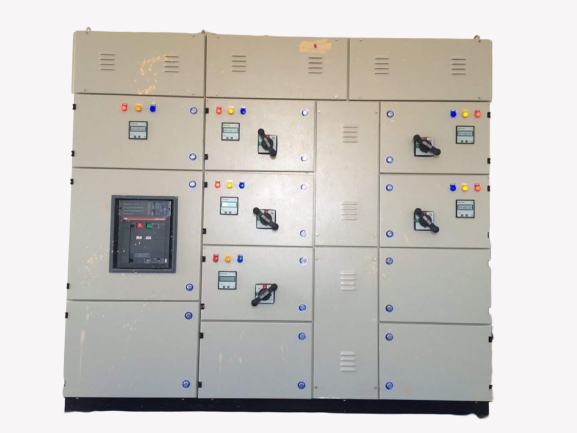
800V LT Panel Boards Built For Project Duty
GEESYS manufactures 800V LT Panel Boards for solar power plants, industrial facilities, renewable evacuation systems, and high-capacity
low-tension AC distribution networks. Each board is configured from the approved single-line diagram, feeder schedule, fault level,
enclosure location, metering requirement, and cable entry plan.
For accurate selection, share the SLD, inverter output details, incoming and outgoing feeder ratings, short-circuit level,
busbar preference, enclosure location, metering requirement, and approved component make list. GEESYS can then prepare a
project-specific 800V LT panel board offer with drawing and documentation support.
Engineering Context For 800V LT Panels
In solar power plants, the AC side is often where layout decisions start to affect actual plant availability. Inverter outputs
must be pooled, feeder lengths must stay practical, and protection coordination must remain selective enough that one fault does
not black out an entire block. An 800V LT panel board sits in this middle layer. It is lower than HT equipment, but it is still
a serious piece of power distribution hardware because it carries combined inverter current, switching duty, and monitoring
responsibility for the site.
For an EPC team, the value of a well designed 800V LT panel board is not only the voltage rating. It is also about how cleanly
the board handles feeder grouping, how clearly it supports maintenance isolation, how well the busbar and cable terminations are
derated for ambient conditions, and how quickly the team can diagnose a fault from the front panel. Those details matter more
than headline marketing claims, because they affect uptime, thermal margin, and commissioning speed.
GEESYS builds these panels for project conditions rather than catalog assumptions. The engineering inputs normally include
inverter make and count, outgoing feeder count, transformer interface, earthing method, short-circuit level, cable route,
ambient temperature, site dust exposure, indoor or outdoor placement, and required metering. That gives the panel a real
technical basis and reduces the chance of duplicate revisions during approval.
Why 800V Matters In Solar LT Distribution
A solar plant operating around 800V AC shifts the design conversation. Compared with a smaller LT board, the panel needs to
handle higher insulation stress, stronger fault energy, and larger combined current from inverter blocks. That changes the
selection of main incomer devices, busbar cross section, termination hardware, and internal clearances. It also changes the
thermal story, because heat rise inside the enclosure becomes a real design variable rather than a secondary check.
In practice, the panel must maintain stable performance in field conditions where ambient temperature, sunlight exposure,
dust, vibration, and irregular maintenance windows all affect long-term reliability. If the enclosure is under-sized or the
wiring chamber is crowded, the result is usually higher hotspot risk and slower fault isolation. A proper 800V LT panel board
is therefore a coordination device as much as it is a distribution device.
This is also why the product is suitable for both solar and industrial users. Many industrial buyers end up using the same class of
board for process loads, plant auxiliaries, or renewable evacuation duties. The technical requirements overlap, but the
accessory package differs, so GEESYS configures the panel around the project instead of forcing one standard layout.
Product Details And Design Inputs
| Parameter |
GEESYS approach |
| Voltage class |
800V AC class LT distribution, configured to project requirement |
| Application |
Solar inverter pooling, plant evacuation, industrial AC distribution, feeder isolation |
| Incoming arrangement |
Single or multiple incomers depending on the approved SLD |
| Outgoing feeders |
MCCB, fuse switch, isolator, or project-specific feeder arrangement |
| Busbar material |
Copper or aluminium, sized for rated current and fault duty |
| Metering |
MFM, CT, indicating lamps, control switches, and energy monitoring options |
| Enclosure |
Indoor or outdoor CRCA enclosure with powder coating and access planning |
| Documentation |
GA drawing, wiring drawing, BOM, test records, and project handover file |
Technical Specification Guide
The specification of an 800VAC LT panel cannot be reduced to a single current rating. A useful specification has to describe the
design envelope, the fault regime, and the service model. That is why GEESYS treats the panel as an engineered assembly with
matching electrical and mechanical inputs. The table below is a practical reference for procurement and engineering teams.
| Item |
Typical range or option |
| Rated voltage |
Up to 800V AC |
| Frequency |
50 Hz or 60 Hz |
| Phase |
Three phase, four wire as per requirement |
| Rated current |
Project specific, based on inverter block or feeder block load |
| Short circuit withstand |
Based on system study and protective device selection |
| Protection devices |
ACB, MCCB, isolator, fuse switch, surge protection, relays |
| Enclosure protection |
IP42, IP54, IP55, or project-specific outdoor level |
| Mounting |
Floor mounted or wall mounted depending on size and access |
| Busbar system |
Insulated or compartmented busbar chamber with heat-rise consideration |
| Instrumentation |
Voltage, current, power, PF, frequency, energy, and fault indication |
Protection Philosophy
Protection is where the panel either behaves like engineered equipment or devolves into a metal enclosure full of parts. GEESYS
keeps the protection philosophy visible from the beginning of the design cycle. That usually means matching the incomer device
curve to the expected fault level, verifying feeder selectivity, arranging CT ratios for the meter and relay combination, and
keeping the control circuit simple enough that commissioning and maintenance remain practical.
If the project requires surge protection, phase indication, healthy-trip lamps, or remote status contacts, the wiring can be
arranged without crowding the main power path. If the site requires field service from the front only, the layout is adjusted
around that access constraint. These details do not sound dramatic on a brochure, but they are the difference between an easy
maintenance window and a panel that requires disassembly for routine checks.
Solar Use Cases
- Solar inverter output pooling before plant evacuation
- AC distribution between inverter blocks and transformer yards
- Metered feeder segregation for utility-scale solar sites
- Power distribution in industrial rooftops and captive solar systems
- Low-tension interface for export and auxiliary load arrangements
Comparison Tables
Comparison tables help procurement teams decide whether the project really needs an 800V LT panel board or whether a more
standard LT board, a solar ACDB, or another downstream distribution stage is more appropriate. The goal is not to oversell
the 800V option. The goal is to place the correct panel in the correct electrical layer.
| Panel type |
Best use case |
Key difference |
| 800V LT Panel Board |
Solar AC pooling, plant evacuation, higher-voltage LT distribution |
Designed for 800V AC class systems with custom feeder and protection architecture |
| Standard 415V LT Panel |
General industrial and commercial distribution |
Commonly used for routine low-voltage loads and standard building distribution |
| HT Panel |
Medium-voltage switching and transformation interface |
Used on the high-tension side and not as a direct replacement for LT distribution |
| Solar product |
Main role |
When to choose it |
| Solar DCDB |
Combines and protects string-side DC circuits |
Choose this before the inverter on the DC side |
| Solar ACDB |
Handles AC-side solar distribution and protection |
Choose this for 415V class AC distribution and metering |
| 800V LT Panel Board |
Higher LT class AC pooling and plant-level evacuation |
Choose this when the project architecture calls for 800V class LT handling |
Reliability, Quality And Documentation
For a B2B electrical product, trust comes from clear specifications, disciplined drawings, component transparency, and
repeatable inspection. GEESYS positions the 800V LT panel board as a documented engineering product with measurable deliverables
rather than a generic assembled enclosure.
The project workflow begins with SLD-driven design inputs and moves through panel layout, component selection, wiring reference,
labeling, and inspection. The same GEESYS product family also includes LT distribution panels, metering panels, AMF panels,
HT panels, Solar ACDBs, and Solar DCDBs, so buyers can source related power distribution equipment from one manufacturer.
From a delivery perspective, the board can be released with bill of material traceability, drawing approval checkpoints,
enclosure finish confirmation, and pre-dispatch electrical testing. For solar EPC teams, that means fewer surprises at site
because the panel is tied to the approved design before fabrication starts.
Documentation And Testing
- General arrangement drawing for dimensional confirmation
- Single-line and wiring drawing for review and shop floor use
- Routine test checks for continuity, polarity, and functional operation
- Busbar and termination inspection before dispatch
- Labeling, ferruling, and cable identification for easier commissioning
If you are comparing LT Panel Board Manufacturer India suppliers, ask for the SLD-based bill
of materials, busbar sizing method, enclosure protection level, test procedure, and cable entry layout. Those documents reveal
whether the panel is engineered or just assembled from parts.
Related GEESYS Products
800V LT Panel Boards are often purchased with other solar AC distribution, DC protection, metering, and switchgear products.
The following GEESYS product pages help buyers compare adjacent equipment before finalizing a plant-level electrical package.
Product Views And Drawing References
The final panel drawing set can include front view, internal general arrangement, busbar chamber, feeder section, cable entry
detail, and wiring reference. These views help consultants, EPC teams, and site engineers verify the panel before fabrication
and during commissioning.
| Reference view |
What it confirms |
| Front general arrangement |
Panel dimensions, door layout, meter position, feeder labels, and operating access |
| Internal busbar chamber |
Busbar routing, support spacing, phase identification, and termination clearance |
| Feeder section |
Breaker rating, outgoing feeder grouping, control wiring space, and maintenance access |
| Cable entry detail |
Top or bottom cable entry, gland plate size, cable bend radius, and field termination plan |
| Wiring and control reference |
Metering circuit, CT wiring, indication lamps, auxiliary contacts, and trip or alarm circuits |
Frequently Asked Questions
These answers cover the most common engineering, procurement, and site execution questions asked before ordering an 800V LT Panel Board.
1. What is an 800V LT Panel Board?
An 800V LT Panel Board is a low-tension AC distribution panel designed for systems that operate up to 800V AC. In
solar plants, it is used for inverter output pooling, feeder isolation, metering, and controlled power evacuation.
2. Who needs a Solar LT Panel Board?
EPC contractors, solar developers, industrial plants, and infrastructure projects need Solar LT Panel Boards when
inverter outputs must be pooled and distributed through a protected LT AC system with metering and maintenance access.
3. How is an 800VAC LT Panel different from a normal LT panel?
An 800VAC LT panel is designed around a higher low-tension voltage class, which changes insulation distance, device
selection, busbar sizing, and heat rise control. A normal LT panel is often built for 415V distribution and may not
suit the same duty without redesign.
4. Can GEESYS customize the LT panel board feeder layout?
Yes. The feeder layout can be customized according to the approved single-line diagram, incoming and outgoing current
ratings, meter arrangement, relay logic, and site cable entry conditions. That is the correct way to specify a project panel.
5. What are the key 800V LT panel specifications to check?
Check voltage class, current rating, short-circuit withstand, busbar material, enclosure protection level, feeder count,
metering, protection devices, cable entry, and whether the design matches the approved electrical study.
6. Is an 800V LT Panel the same as a solar ACDB?
No. A solar ACDB usually refers to the AC-side distribution board for standard solar plant voltage levels, while an
800V LT Panel Board is intended for a higher LT class architecture. They are related, but not interchangeable.
7. Why do buyers search for LT Panel Board Manufacturer India?
Buyers use that query when they need a local manufacturer who can handle project drawing review, custom fabrication,
test support, and faster delivery for Indian site conditions rather than a generic trading listing.
8. What details should be shared for a quote?
Share the single-line diagram, feeder schedule, current rating, busbar preference, enclosure location, fault level, meter
requirement, dimensions, and the desired delivery timeline. That is enough for a usable technical quotation.
9. Why choose GEESYS for 800V LT Panel Boards?
GEESYS supports project-specific 800V LT panel board manufacturing with SLD-based design inputs, feeder layout planning,
busbar and enclosure selection, wiring documentation, routine inspection, and practical support for solar and industrial sites.
Order Inputs And Delivery Support
To begin an 800V LT Panel Board enquiry, send the approved or preliminary SLD, inverter block details, transformer interface,
feeder schedule, fault level, cable sizes, cable entry direction, preferred component makes, enclosure location, and metering
requirement. GEESYS reviews these inputs before finalizing the offer so the panel quotation reflects the actual project duty.
After order confirmation, the panel can move through drawing approval, enclosure fabrication, component mounting, busbar assembly,
control wiring, labeling, internal inspection, and pre-dispatch checks. This process helps EPC contractors, consultants, and plant
owners maintain better control over drawing comments, site readiness, and commissioning documentation.
Request A Project Quote
GEESYS supplies 800V LT Panel Boards for solar power plants, industrial facilities, infrastructure projects, and renewable energy
distribution systems across India. Share your project electrical inputs to receive a panel proposal with ratings, enclosure details,
feeder configuration, metering options, documentation scope, and delivery schedule.